

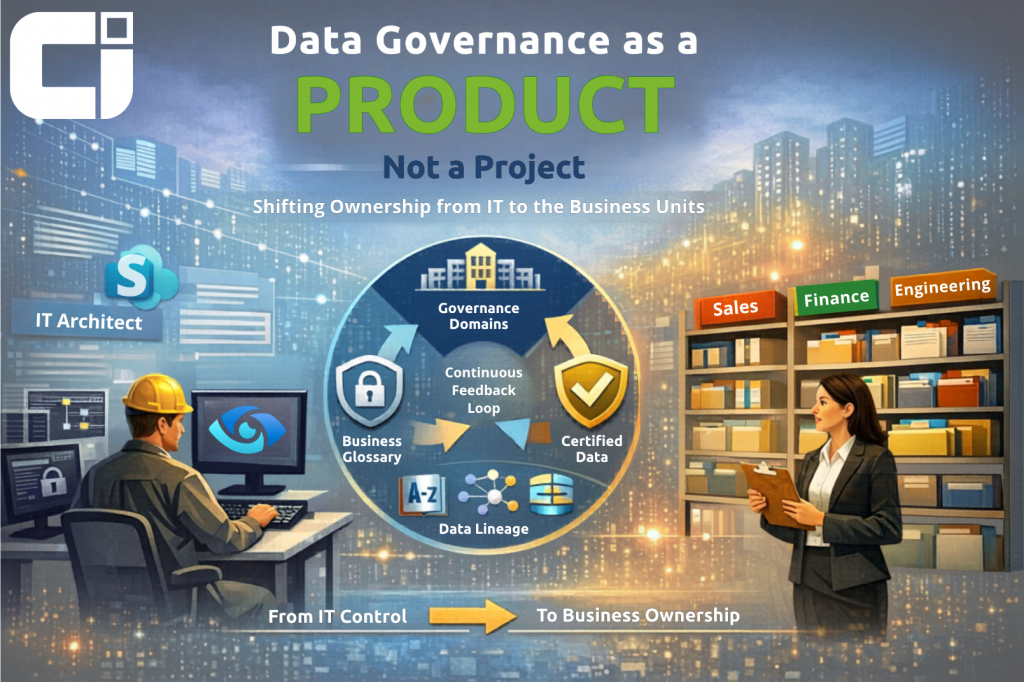
Shifting Ownership from IT to the Business Units
In most organizations, the phrase data governance triggers an immediate collective groan. Businesses often view it as a restrictive IT project, a set of rules designed to stop people from doing their jobs. One that a department manages without actually being a user of the data being governed. Yet Microsoft Purview takes a fundamentally different approach, so that the people closest to the data should be the ones responsible for it.
The Conflict: The Data Governance Project Paradox
Consider this common scenario: An IT Administrator is looking at a massive SharePoint library for Data Governance Project. No one has touched it in three years. Is it a historical record that must be preserved for legal reasons? Or simply a redundant draft that can be deleted to save costs?
IT cannot answer that question. The Sales Manager or the Lead Engineer, however, can. IT-owned governance creates bottlenecks and Dark Data, stored, searchable information that generates only noise and risk. Conversely, when the business units take the lead, governance transforms from a technical hurdle into a natural business process. As a result, this turns stagnant data into a strategic, high-velocity asset.
The Purview Solution: Governance Domains
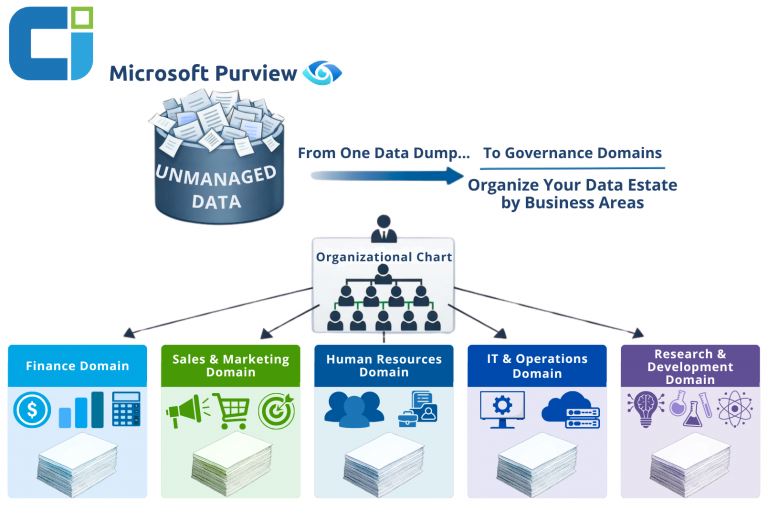
Microsoft Purview has fundamentally changed this dynamic by introducing Governance Domains. In turn, one giant, unmanageable data dump becomes logical business areas that mirror your actual organizational chart.
Data Governance as a Product, Not a Project
In the old model, data governance was a project; something with a start date, an end date, and a dusty manual no one read after the consultants left. To succeed in an AI-driven world, we must treat governance as a product.
Unlike projects, products never reach the finish line. They have lifecycles, demand ongoing maintenance, and most importantly, rely on a constant feedback loop between the developers and users.
Actionable Tip: The Data Steward
If you want governance to stick, you need Data Stewards. This is not a new full-time hire. It is a role assigned to a subject matter expert within a business unit.
- Their Job: To review data quality, approve access requests for their domain, and ensure their team is following labeling protocols.
- The Result: IT steps out of the “No” department role and becomes an enabler, while the business takes pride in the quality of its own data.
The Librarian vs. Architect Model
To make this product work, we redefine the relationship between IT and the Business Units. In practice, this means redefining what each party is responsible for:
- IT as the Architect: Your IT team designs the structural foundation of the library, building digital shelves through SharePoint architecture and metadata structures that keep data organized and searchable. Security sensors like Sensitivity Labels and access rules through Identity Controls deliver persistent, automated protection. Together, these elements provide the infrastructure for full speed business operations, eliminating constant manual gatekeeping.
- The Business as the Librarian: The business units stock and manage the books. As subject matter experts, they know which data counts as a Current Truth and which is outdated or unstructured. This includes previous versions, outdated project iterations, and older information that no longer holds business value. To IT, a document from three years ago looks like data. To the Librarian, it is clearly identified as an obsolete draft to archive or delete before it confuses staff or AI.
The Continuous Feedback Loop
If the Architect builds a shelf that is too high for the Librarian to reach, the system breaks. It follows then, that a Product mindset requires a Continuous Feedback Loop.
In our assessments, we emphasize that governance is a two-way street:
- Business Feedback to IT: The Sales or Finance teams (the Librarians) report when a security label restricts collaboration or when a metadata field confuses users. This open dialogue prevents security from becoming an obstacle that drives employees toward unsecure workarounds or Shadow IT. Real-world feedback lets the Architect refine labels and metadata. Over time, this refinement keeps the library functional and intuitive.
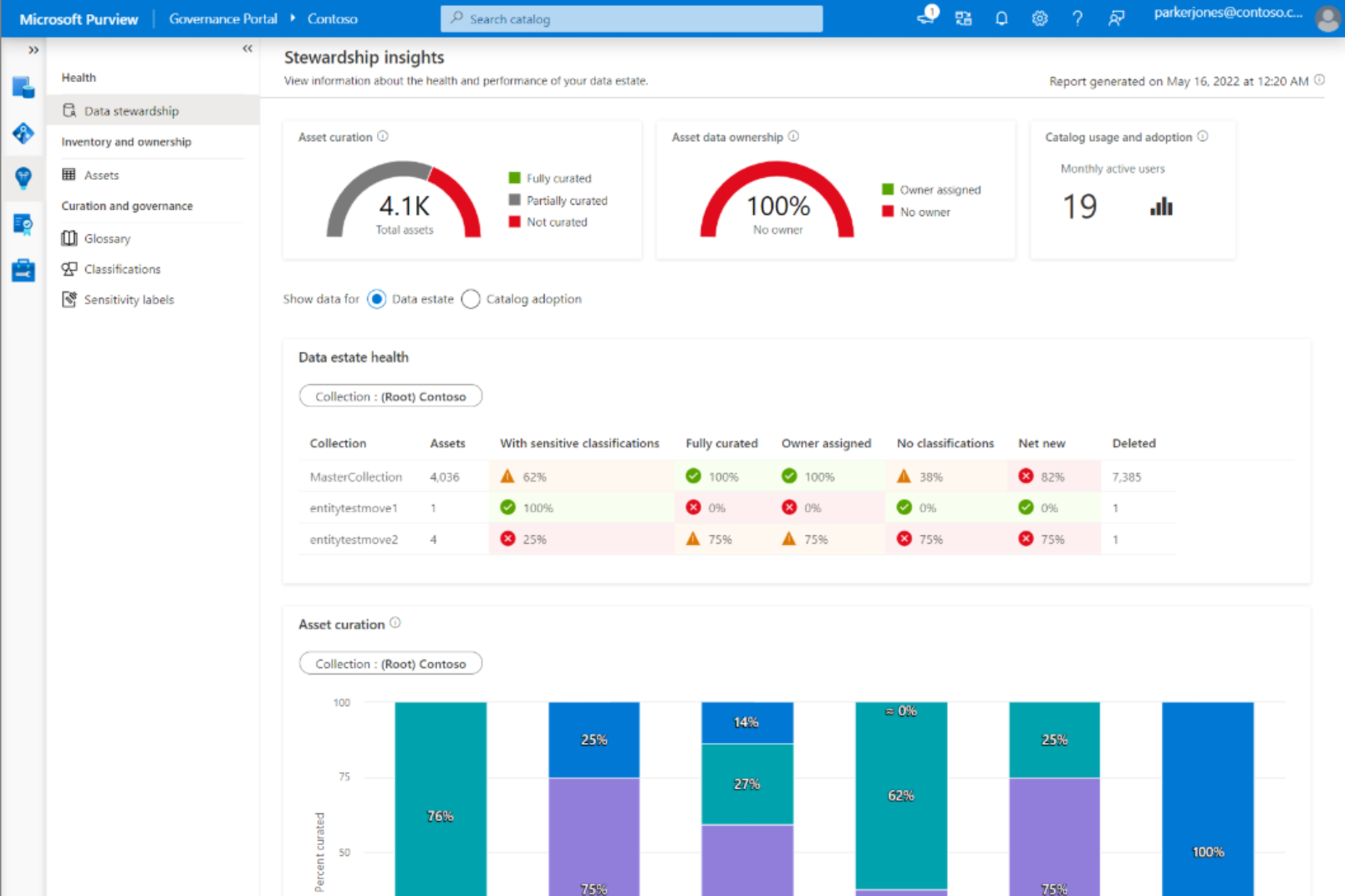
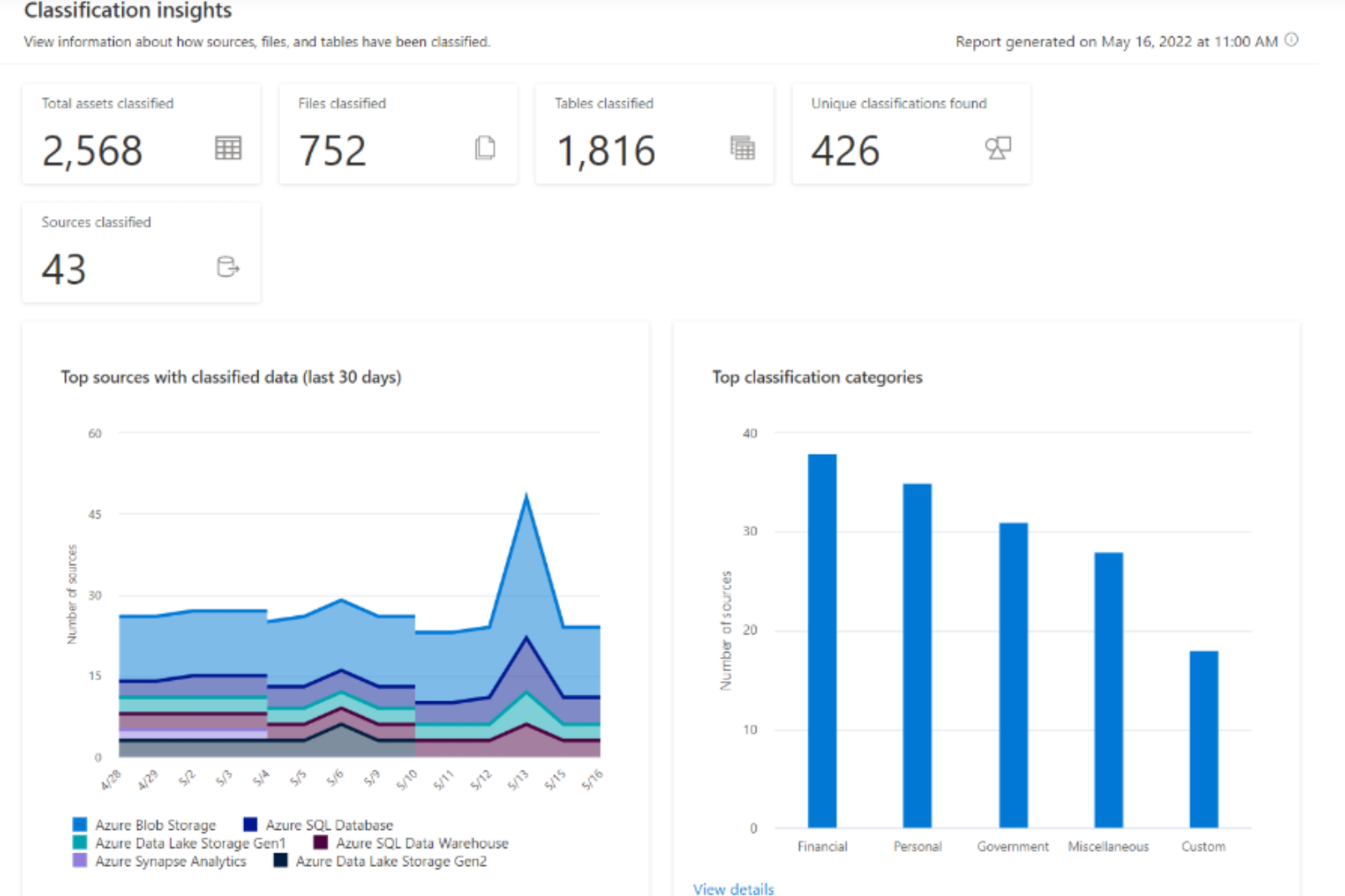
- IT Adjustments to Business: IT (the Architect) monitors the Data Estate Insights and alerts the business when a specific domain spikes in Unlabeled Content or Overshared Links. Rather than gatekeeping, IT gives business leads the visibility to manage their own data health. As a result, department heads can proactively address risks, like sensitive files residing in public folders, before they become compliance events. (The Purview Data Estate Insights are illustrated in the diagrams below.)
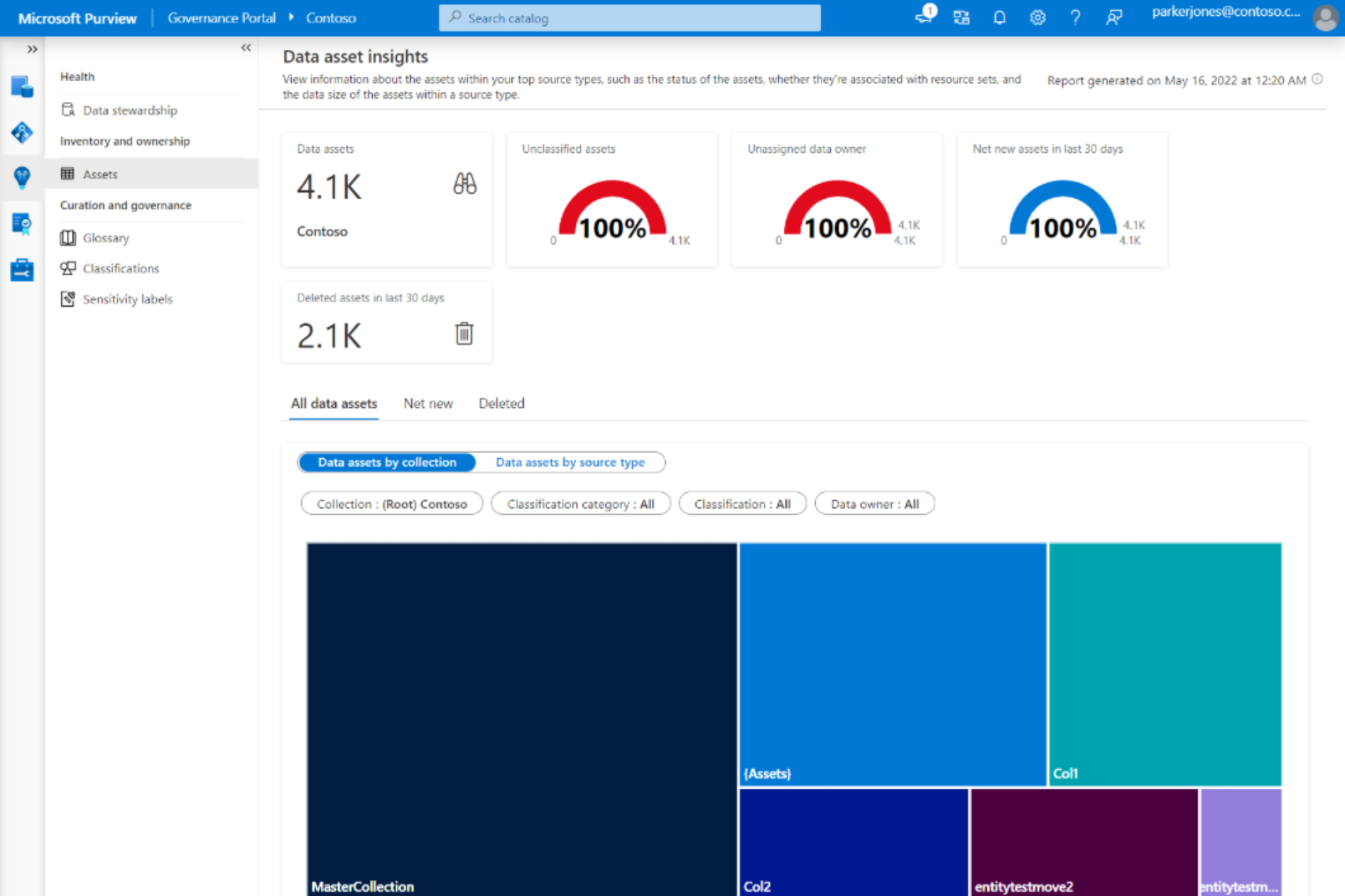
The Result: Instead of IT being the Compliance Police, they become the Compliance Partners. As a result, the system evolves based on how the work actually gets done.
The Value of the Unified Catalog: Simplifying the Search for Truth
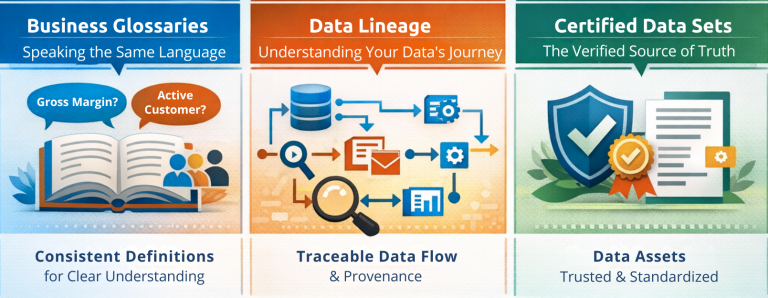
Beyond ownership structure, the Unified Catalog addresses another daily drain on productivity. The average employee wastes hours every week simply looking for information. Purview’s Unified Catalog acts as a Google for your Enterprise Data, delivering the context and trust needed for high-stakes decision-making. It offers:
- Business Glossaries (Speaking the Same Language): Data fails when departments interpret the same term in different ways. Is Gross Margin calculated before or after shipping? Does Active Customer mean a signed contract or a recent login? Purview’s Business Glossary breaks down terminological silos by providing a centralized, agreed-upon set of definitions. As a result, every stakeholder, from Finance to Marketing, reads from the same playbook when building a report.
- Data Lineage (Understanding the Story of Your Data): Trust in data comes from knowing its DNA; its origin, every transformation it underwent, and where it eventually landed. Purview maps this journey virtually, making it indispensable for regulatory reporting and internal audits, where every figure must be defensible. Beyond compliance, lineage gives teams a vital technical reference for tracking product versions and documentation changes. Suspicious Q4 figures? Simply trace every transformation back to the exact source, protecting both technical and financial integrity.
- Standardization through Certified Data Sets (The Verified Source of Truth): In a sea of fragmented files, certification is the formal seal of approval that separates raw data from reliable assets. Purview lets Data Stewards mark files as the organizational Gold Standard, signaling to analysts and AI tools that this information has passed quality review. Crucially, Data Stewards can also annotate certified versions with context and usage notes, ensuring absolute clarity before sharing. This eliminates the risk of using outdated or unverified drafts. Furthermore, every user understands the “how” and “why” behind the official version.
Measuring the Product Success: The KPIs that Matter
With ownership defined and feedback loops in place, governance becomes measurable. Traditionally the IT project model turns governance into a budget line item, constant funding with little visible return. At Collective Intelligence, we shift that model by operationalizing governance exactly where it belongs, with the business owners.
By embedding governance into your natural business processes, it stops being a task and starts being the way you work. As a result, your data estate becomes more cost-effective, highly visible to leadership, and most importantly, actionable for your teams.
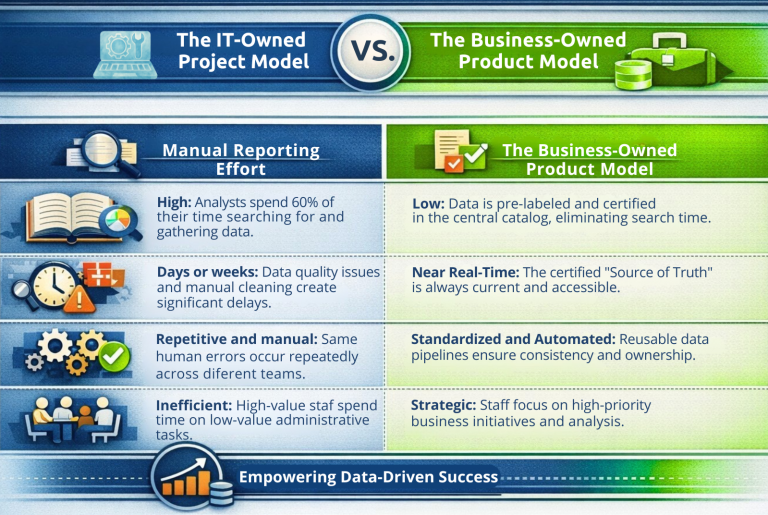
Key Differences:
- IT-Owned Model: Reactive, process-heavy, time-consuming, high-cost
- Business-Owned Model: Proactive, automated, value-creating
How Collective Intelligence Can Help
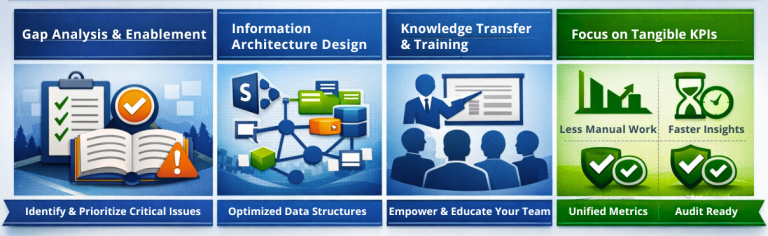
At Collective Intelligence (CI), we do not just “turn on” software; we design the organizational structure that makes technology work for people. Our proven assessment-led approach bridges the gap between technical configuration and business adoption.
- Gap Analysis & Enablement Assessments: We begin by identifying vulnerabilities and areas for improvement. Problems get prioritized, not just listed, so critical security issues come first, aligned with your unique operational requirements. From there, our Information Architecture Design work begins.
- Information Architecture Design: Additionally, as specialists in Microsoft shop environments, we design SharePoint metadata structures that make data “searchable” for AI and “discoverable” for humans.
- Knowledge Transfer & Empowered Handoffs: More importantly, we believe in long-term sustainability, not dusty manuals gathering digital cobwebs after the consultants leave. As such, every engagement includes comprehensive documentation, step-by-step guides, and hands-on “Train the Trainer” sessions designed for real-world use. We never just drop off a binder and disappear. CI leaves an active, living plan, complete with every tool, runbook, and operational training resource your team needs to maintain solution. Outdated PDFs will not be your fallback. Instead, you will have a working system and the knowledge and confidence to own it from day one.
- Focus on Tangible KPIs: Above all, our goal is to move your high-value talent away from tedious administrative work. We measure our success through:
- Reduction In Manual Reporting Effort: Minimizing the “grunt work” required to pull data.
- Time Saved on Data Preparation: Streamlining the path from raw data to actionable insight.
- Standardization of Metrics: Ensuring a single, verified definition of truth across the entire organization.
- Accelerated Audit Readiness & Regulatory Response: Utilizing automated lineage to provide a defensible, transparent trail for every figure, drastically reducing the time spent on regulatory reporting and internal audits.
The CI Architect Secret: Documentation is the Blueprint
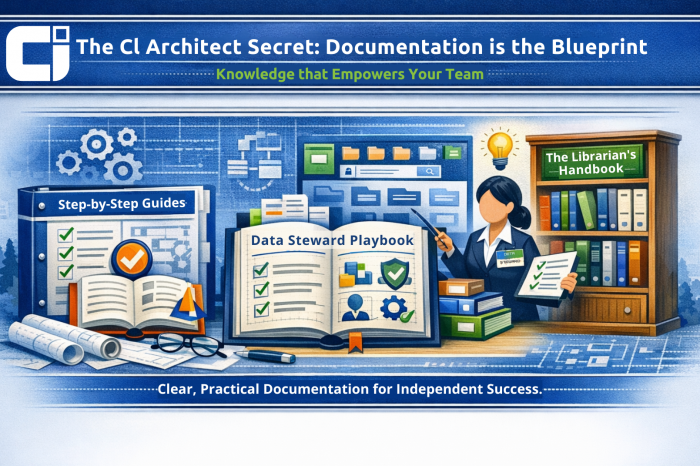
One reason governance projects fail is that the instruction manual is missing. For that reason, in our assessments, we do not just configure your environment, we provide the Step-by-Step Guides and Knowledge Transfer sessions.
This ensures that when your Sales Manager becomes a Data Steward, they already have a clear, non-technical playbook to follow. Beyond handing over a library, CI delivers the Librarian’s handbook ensuring the environment stays valuable long after we leave.
Conclusion: Governance as an Engine, Not a Brake
Data governance is often treated like a brake, something that slows you down. But in a high-performance vehicle, brakes are what allow you to go faster. Accurate, labeled data, owned by the right people, lets your organization move at the speed and confidence the age of AI demands.
Ultimately, governance is not about restriction; it is about making data useful, trustworthy, and ready for work.
Take the First Step: The CI Gap Analysis
Is your data a hidden liability or a strategic asset? At Collective Intelligence, we help you clear the fog. Our GAP Analysis and Assessment pinpoints exactly where your governance stands today and maps a prioritized roadmap for tomorrow. We go even further than a report; Train the Trainer sessions and step-by-step guides empower your business units to lead.
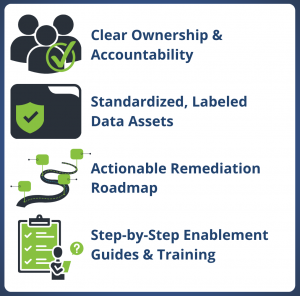
Your data strategy will not fix itself, but it does not have to be overwhelming either. Fortunately, whether you need to close a governance gap, make your data AI-ready, or simply know where to start, CI assessment is designed to uncover exactly that.
Talk to our team or schedule a 30-minute session, and leave with a clear picture of where you stand and what to tackle first.