


Why the biggest threat to your data is likely a tired employee, not a hacker.
When we talk about cybersecurity, the mental image is almost always the same. Most people imagine a nameless, faceless hacker in a dark room halfway across the world, trying to crack the code. Organizations spend millions on digital moats and high-tech drawbridges to keep these intruders out. However, the greatest risk might already be inside the castle. This person has a key to the front door and simply wants to finish a report by 5:00PM.
The Burnout Breach
Modern data leaks usually result from habits rather than criminal heists. Most data loss occurs because employees feel tired, rushed, or frustrated. Clunky security hurdles often drive these dangerous behaviors.
Consider the marketing manager who exports a customer list to their personal drive. They do this because the corporate sharing link is failing. Similarly, a tired HR associate might accidentally email the wrong document, such as the 2026 Compensation Strategy instead of the Holiday Calendar. These Unintentional Insiders are not trying to hurt the company. Instead, they are simply trying to do complete their daily tasks.
Finding the Happy Medium: Protection Without the Friction
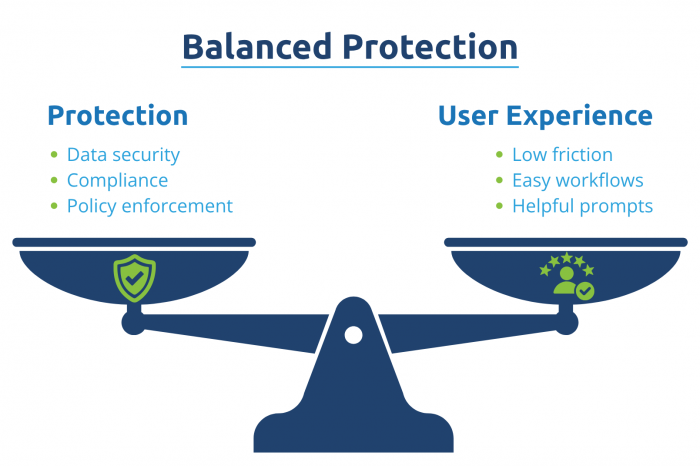
Security fails the moment it becomes a burden for the user. Staff will inevitably find workarounds if a policy is too cumbersome. This creates Shadow IT and increases overall risk.
Consequently, organizations must find a happy medium. You should protect data without placing a heavy tax on the workforce. They key involves adjusting security methods rather than lowering protection levels. Automated labeling and intuitive prompts make guidelines much easier to follow. When security feels like a helpful assistant rather than a roadblock, compliance becomes the path of least resistance.
Moving to Adaptive Protection: Security that Learns
Traditional security is often binary. It is either on or off. If you set your Data Loss Prevention (DLP) policies too tight, you kill productivity. Conversely, If you set them too loose, you leak data.
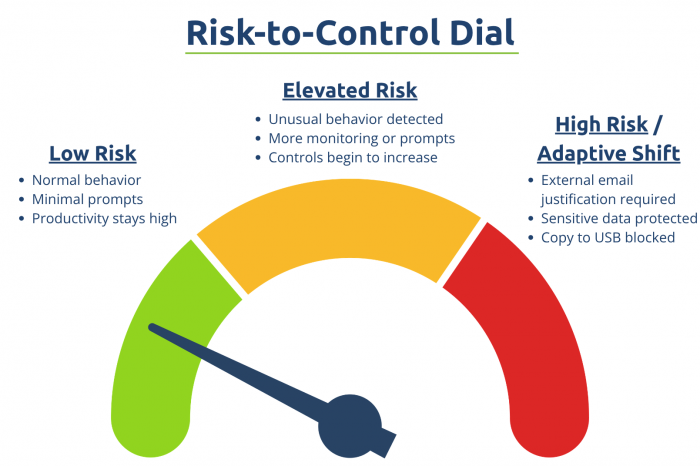
Microsoft Purview solves this through Adaptive Protection. This system tunes indicators and remediation paths automatically. High-risk users receive tighter controls while others remain productive. Purview uses machine learning to assign a dynamic risk level to users based on their behavior:
- Low Risk: An employee performs their usual tasks. Security remains largely invisible. As a result, they can work at high speed without unnecessary interruptions.
- Elevated Risk: Behavior shifts suddenly. Perhaps a user suddenly began downloading bulk files from a SharePoint site they rarely visit. Alternatively, they may have recently submitted their resignation notice.
The Adaptive Shift: Purview then automatically tightens the leash for that specific user. For instance, it might block Copy to USB functions, or trigger justification for external emails. This secures sensitive data throughout its entire lifecycle.
The Privacy Frontier: Customizing Pseudonymization
A major concern with insider risk management is the feeling of being watched. Purview addresses this through pseudonymization. This feature hides user identities during the initial stages of a risk review. This is highly customizable. For example, you can define which administrative roles have the authority to unmask a user and under what specific conditions.
This privacy-first approach scales with the risk levels mentioned above. For a low-risk user, their identity remains entirely anonymous to the system’s oversight. Identity is only revealed if a specific set of high-risk indicators, such as the Adaptive Shift, is met. Identity is only revealed during formal investigations. This ensures the business stays protected without spying on staff. As a result, the business remains protected by an objective, pseudonymized safety net.
How Collective Intelligence Can Help
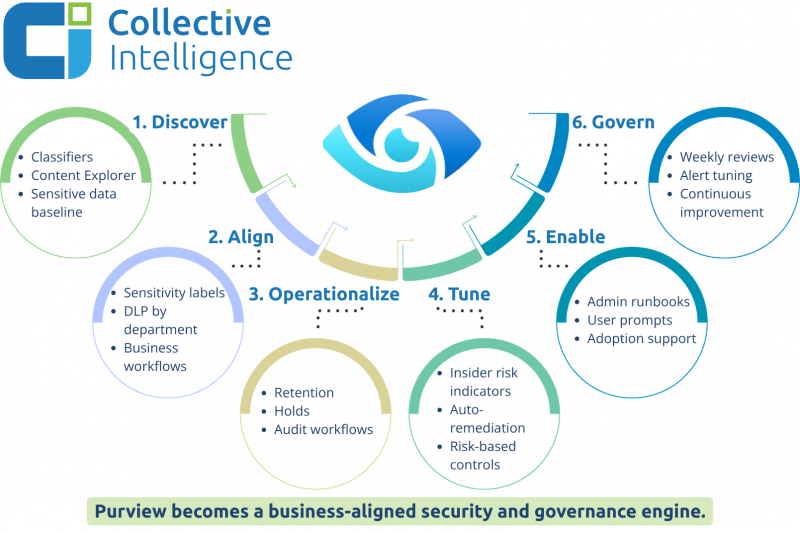
At Collective Intelligence, we do not just deploy Purview, we make it deliver results. We turn it into a fully operational, business-aligned security engine for data security and governance. Our playbook includes:
- Rapid Discovery and Baseline: We light up Purview’s discovery stack, including classifiers and Content Explorer, to reveal where sensitive data lives and moves.
- Business-Aligned Labeling and DLP: We design sensitivity labels and DLP policies that mirror how your organization actually works across all departments, such as, HR, Legal, Finance, and Operations.
- Compliance and Records Operationalization: We codify holds, retention, and audit workflows to give your teams repeatable, defensible processes.
- Insider Risk Tuning: We configure indicators and auto-remediation paths to protect your data estate from both malicious and unintentional threats.
- Change Management and Enablement: We deliver the admin runbooks and user prompts needed to drive real adoption and reduce operational friction.
- Ongoing Governance: Through weekly governance and alert reviews, we keep your program healthy and evolving.
Protecting the Human, Not Just the File
Modern data protection is a psychology game. Most leaks result from friction and fatigue. Consequently, we should build systems that protect employees rather than punish them. Adaptive Protection and pseudonymization respects privacy while allowing us to create a secure environment that maintains productivity. Security is at its best when it is invisible to the diligent and impenetrable to the risky.
Take the Next Step: The CI Purview Discovery Assessment
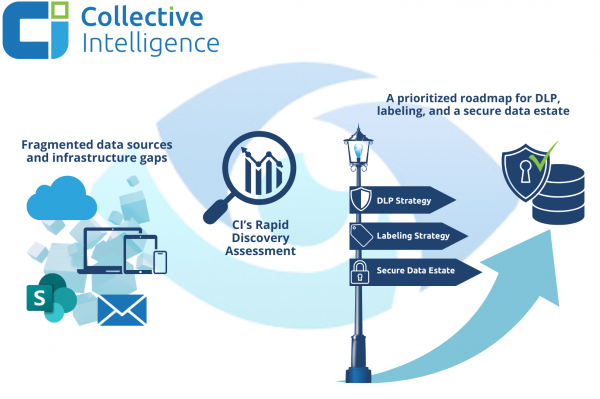
Most organizations struggle not with Purview itself, but with the complexity of fragmented data sources and labor-intensive setup. At Collective Intelligence, we help you bypass this complexity. Our Rapid Discovery Assessment provides a prioritized roadmap for your DLP and labeling strategy. We help you fix identity and infrastructure gaps that Purview alone cannot mitigate, ensuring your data estate is secure from the inside out.