

What Every Public-Facing Organization Needs to Know Now
Across government, education, healthcare, and financial services, digital accessibility is no longer a future initiative. It is a current operational, legal, and reputational requirement. Websites, web applications, and digital services must be usable by everyone, including individuals who rely on assistive technologies such as screen readers, keyboard navigation, or voice input. Yet many organizations remain only partially compliant or unaware of their exposure.
What Section 508 and WCAG Actually Mean
Across government, education, healthcare, and financial services, digital accessibility is no longer a future initiative. It is a current operational, legal, and reputational requirement. Websites, web applications, and digital services must be usable by everyone, including individuals who rely on assistive technologies such as screen readers, keyboard navigation, or voice input. Yet many organizations remain only partially compliant or unaware of their exposure.
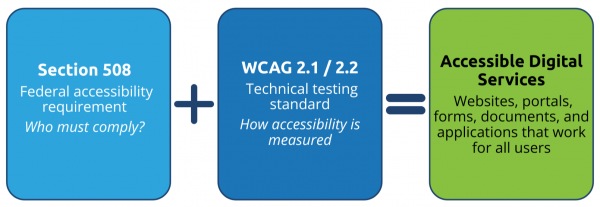
Section 508 is a U.S. federal requirement mandating that digital content and systems be accessible to individuals with disabilities, particularly for organizations that receive federal funding or sell to government entities.
WCAG (Web Content Accessibility Guidelines) provides the technical standard used to measure accessibility. WCAG 2.1 and 2.2 define clear, testable criteria across four core principles:
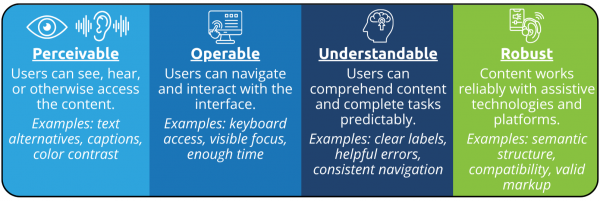
- Perceivable – Content must be presented in ways users can perceive
- Operable – Interfaces must work for all users, including keyboard-only navigation
- Understandable – Content and interactions must be clear and predictable
- Robust – Content must work with assistive technologies across platforms
These standards are not theoretical. They are actively used as the baseline for ADA enforcement and accessibility litigation.
Why the Urgency Is Increasing
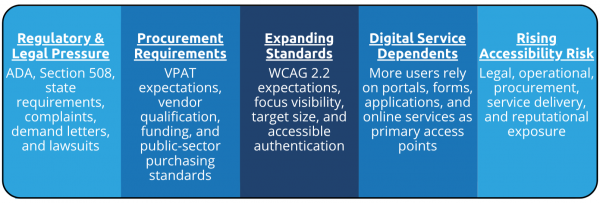
Accessibility compliance is accelerating from “best practice” to “expected standard” across all sectors:
1. Regulatory and Legal Pressure: Organizations subject to ADA Title III, Section 508, or state-level regulations are facing increased scrutiny. Accessibility issues are now a common trigger for demand letters and lawsuits, often centered on websites, portals, and online services.
2. Procurement Requirements: For public sector and higher education organizations, accessibility is now embedded in procurement. Many agencies require a VPAT (Voluntary Product Accessibility Template) as part of the purchasing process, without it, vendors may be disqualified.
3. Expanding Standards: WCAG 2.2 introduces additional criteria (such as focus visibility, target size, and accessible authentication) and is increasingly expected for new systems and redesigns.
4. Digital Service Dependence: Constituents, students, patients, and customers increasingly rely on digital access as their primary interaction point. Accessibility gaps now directly impact service delivery, not just compliance posture.
What Non-Compliance Actually Looks Like
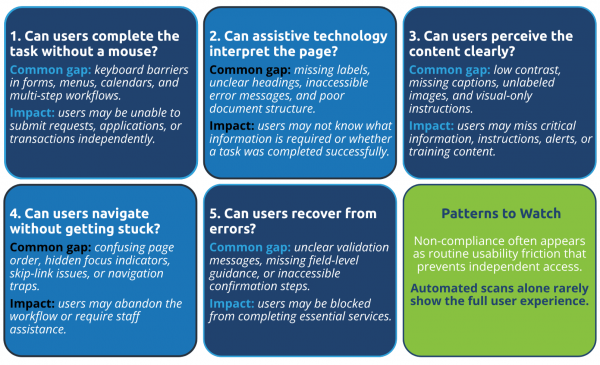
Most organizations are surprised to learn that accessibility issues are not limited to obvious visual barriers. Common failures include:
- Forms that cannot be completed using a keyboard
- Missing labels or error messaging that screen readers cannot interpret
- Poor color contrast that makes content unreadable
- Navigation structures that trap or confuse users
- Videos without captions or transcripts
These issues are often not fully detected by automated tools alone and require deeper evaluation.
The Hidden (and Increasing) Cost of Waiting
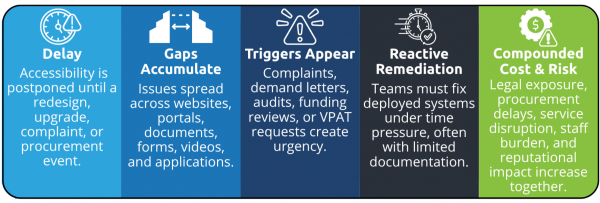
Many organizations assume accessibility can be addressed “later”, often tied to a future redesign, platform upgrade, or compliance initiative. In practice, delaying action tends to increase both risk and cost across multiple dimensions simultaneously.
1. Legal and Reputational Exposure Arrives on Its Own Time
Accessibility issues rarely surface on an organization’s own schedule. They typically emerge through user complaints, ADA or Section 508 demand letters, advocacy group reviews, or funding audits. Organizations are then forced from unaware to reactive, with limited time to respond. Responding effectively requires more than a quick fix. It requires documented evidence of evaluation, remediation planning, and progress. Many organizations do not have that documentation. Digital services are also visible to the public. Websites are easy to evaluate externally. Complaints can escalate quickly through social and professional channels. This is especially true in education, healthcare, and government. In those sectors, accessibility is closely tied to equity and public trust.
2. Remediation Costs Increase Exponentially After Deployment
Accessibility is far less expensive to address proactively than retroactively. When issues are discovered post-launch, development teams must revisit completed work. UI/UX patterns may require full redesign rather than minor fixes. Content must be reformatted at scale across documents, videos, and forms. Dependencies between components also create cascading fixes. Identifying issues early allows teams to address root causes once. That is more efficient than fixing the same problems repeatedly across multiple systems. WCAG 2.2 also introduces newer requirements around focus visibility, target size, and accessible authentication. These criteria are increasingly expected in new builds. Organizations aligned only to older standards may fall further out of step over time. Waiting does not pause compliance risk. It allows that risk to grow.
3. Procurement, Funding, and Service Delivery Are Directly Affected
For public sector, higher education, and federally connected organizations, accessibility is now embedded in procurement. Vendors without VPAT documentation aligned to WCAG/508 may be disqualified. They may also face last-minute remediation demands. Procurement cycles can stall and projects can be delayed at approval stages. These delays are often more disruptive than the audit itself. Beyond procurement, accessibility gaps affect real people. Constituents may be unable to apply for benefits. Students may be locked out of course portals. Patients may be unable to use telehealth systems. Customers may not be able to complete online transactions. When these barriers exist, users abandon workflows. Staff must then intervene manually, increasing operational burden. Organizations also risk failing to deliver core services equitably. This shifts accessibility from a compliance topic to an operational continuity issue.
4. Without Documentation, Even Active Efforts Carry Risk
Even organizations actively improving accessibility remain exposed without formal documentation. That documentation must cover what was tested, what issues were identified, and what remediation actions are planned or completed. Without this record, teams cannot demonstrate progress to leadership or auditors. Procurement teams also lack required VPAT documentation. Institutional knowledge is lost as projects and staff change. A structured audit provides the defensible baseline needed to support ongoing compliance, procurement, and governance efforts.
Bottom Line
Waiting to address accessibility rarely results in a “better time” to act. Instead, it increases exposure, raises costs, and reduces control over how and when issues are addressed.
Organizations that move early gain:
- Clear visibility into their current state
- A prioritized, manageable remediation plan
- Documentation to support compliance, procurement, and governance
- Reduced risk across legal, operational, and reputational dimensions
How Collective Intelligence Can Help
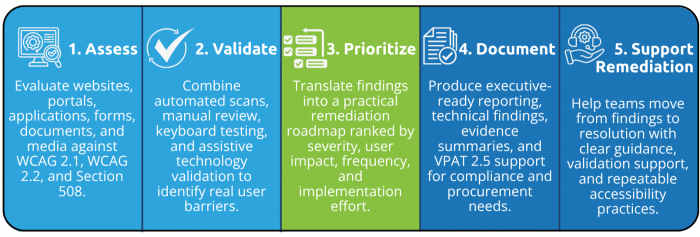
At Collective Intelligence, we provide end-to-end accessibility audit and remediation support designed specifically for organizations operating under regulatory and public accountability pressures.
Our approach goes beyond automated scans:
- In-depth testing across WCAG 2.1, WCAG 2.2, and Section 508
- Real assistive technology validation
- Clear, prioritized remediation guidance for development teams
- Executive-ready reporting for leadership and compliance stakeholders
- VPAT 2.5 documentation to support procurement and regulatory needs
Each engagement produces a structured, actionable roadmap, not just a list of technical findings, so your team can move directly from assessment to resolution. Our process is designed to be repeatable, giving your organization a sustainable framework for ongoing compliance rather than a one-time fix.
A Practical Next Step
If your organization has not conducted a formal accessibility audit in the past 12–18 months, or if you are preparing for a redesign, new platform launch, or procurement review, now is the right time to establish your baseline.
Accessibility compliance is no longer optional. It is part of delivering equitable, modern digital services, and it is increasingly expected by regulators, partners, and the communities you serve.