
Breaking down the Microsoft Island myth to govern data wherever it lives.
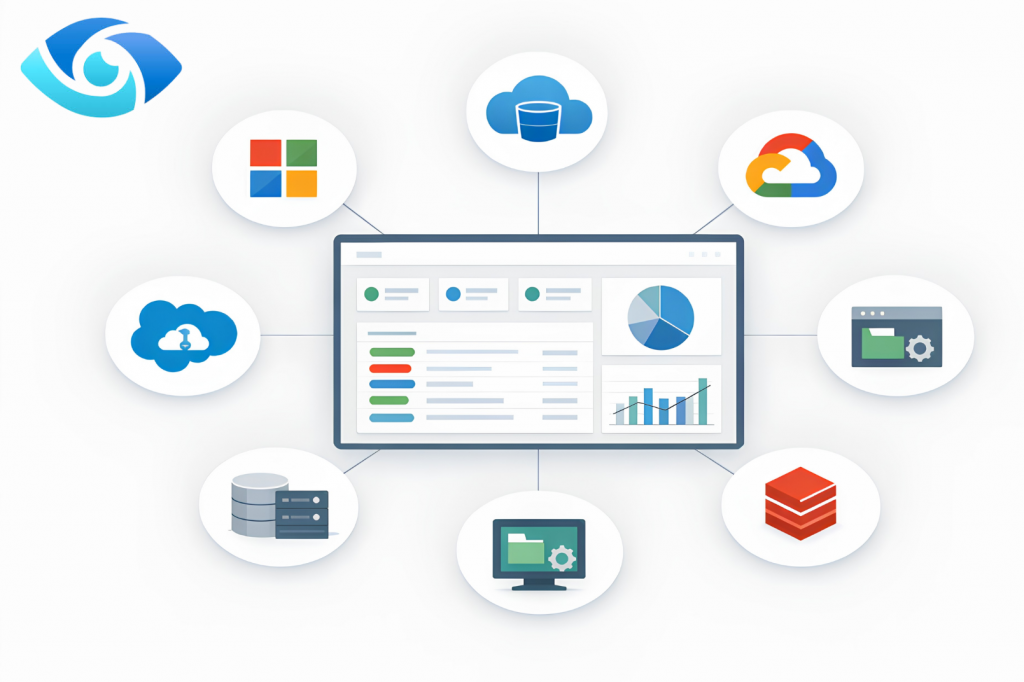
For many years, a common misconception kept risk officers and data architects up at night. Many believed that choosing Microsoft Purview for multi-cloud governance meant stranding your organization on a Microsoft Island. The assumption: Purview worked beautifully if your entire universe existed inside Exchange, SharePoint, and OneDrive, but left you entirely blind the moment your data crossed into competing environments.
In the early days of cloud computing, that assumption had merit. Clinging to that old mindset today, however, creates a major operational liability.
Your Data is Everywhere. Your Governance Should Be Too.
Walk into almost any mid-sized or enterprise organization today, and you will not find a pure, single-vendor ecosystem. You will find a highly fragmented data estate.
Your marketing analytics might be hosted in an AWS S3 bucket. Core product transactional data may be managed in a Databricks lakehouse environment. Developers spin up databases in Google Cloud, while sales pipelines depend on external SaaS applications.
A data governance strategy that monitors only Microsoft tools does not run a true governance program. Instead, it guards one room in a house with unlocked windows. To manage critical risks and regulatory requirements, your visibility must be stretched as far as your data extends.
The Purview Solution: The Single Pane of Glass for Hybrid Estates
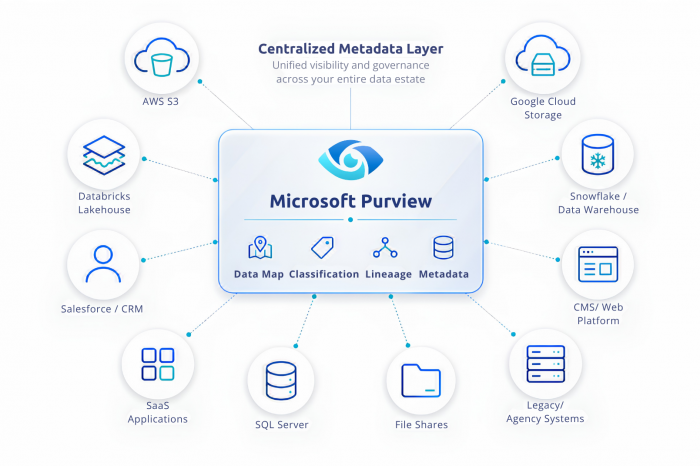
From a strategic perspective, centralized multi-cloud data governance creates a compelling cost-benefit reality check. When metadata scatters across separate cloud platforms, SaaS tools, databases, and local systems, leadership must make risk decisions from an incomplete picture. Each platform may offer some visibility into its own environment. But no single team can confidently answer the broader business questions: Where does sensitive data live? Who owns it? How is it moving? Which systems are creating the greatest compliance exposure?
Centralized metadata changes that equation. By bringing classifications, ownership details, lineage, and source-system context into one governance layer, organizations gain a reusable intelligence asset instead of a collection of disconnected inventories. This cuts duplicated discovery efforts, lowers the administrative burden on IT and data teams, and gives compliance stakeholders a more defensible basis for prioritizing remediation.
The practical benefit is clear: siloed tools tell you what is happening in one system. Centralized metadata helps you understand what is happening across the enterprise. That difference matters when preparing for audits, responding to incidents, enabling AI adoption, or deciding where to invest limited security and governance resources.
Once sources are scanned, the value extends beyond simple inventory. Data teams can search across the unified catalog, compare similar assets across systems, and identify where the same types of sensitive information appear. This holds true regardless of whether the data originated in Microsoft 365, AWS, Google Cloud, Databricks, Salesforce, an on-premises database, or another supported source. As a result, stakeholders can move seamlessly from discovery to comparison to prioritization within a single governance experience.
Consultancy Insight: Centralized Metadata vs. Siloed Blindness
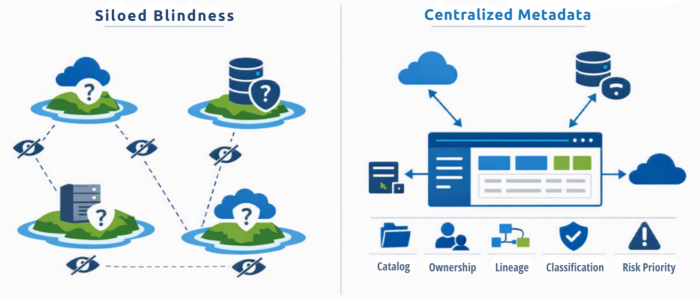
From a strategic perspective, centralized multi-cloud data governance creates a compelling cost-benefit reality check. When metadata is scattered across separate cloud platforms, SaaS tools, databases, and local systems, leadership is forced to make risk decisions from an incomplete picture. Each platform may provide some visibility into its own environment, but no single team can confidently answer the broader business questions: Where does sensitive data live? Who owns it? How is it moving? Which systems are creating the greatest compliance exposure?
Centralized metadata changes that equation. By bringing classifications, ownership details, lineage, and source-system context into one governance layer, organizations gain a reusable intelligence asset instead of a collection of disconnected inventories. This reduces the need for duplicated discovery efforts, lowers the administrative burden on IT and data teams, and gives compliance stakeholders a more defensible basis for prioritizing remediation.
The practical benefit is simple: siloed tools tell you what is happening in one system, while centralized metadata helps you understand what is happening across the enterprise. That difference matters when preparing for audits, responding to incidents, enabling AI adoption, or deciding where to invest limited security and governance resources.
Once those sources have been scanned, the value extends beyond simple inventory. Data teams can search across the unified catalog, compare similar assets across systems, and identify where the same types of sensitive information appear, regardless of whether the data originated in Microsoft 365, AWS, Google Cloud, Databricks, Salesforce, an on-premises database, or another supported source. Instead of manually checking each platform in isolation, stakeholders can move seamlessly from discovery to comparison to prioritization within a single governance experience.
The Technical Reality of Multi-Cloud Scanning
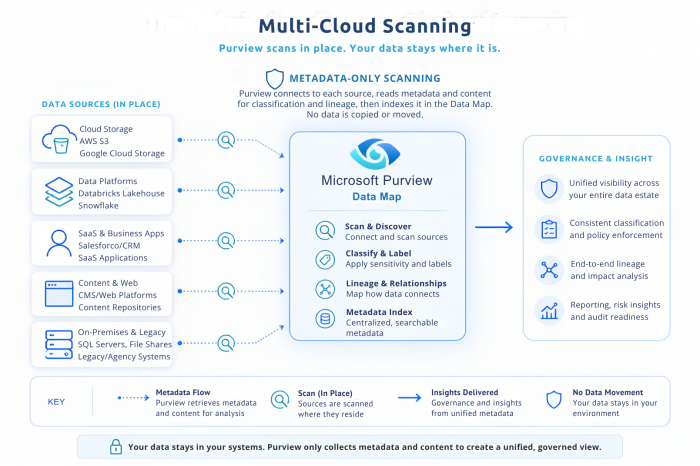
Understanding what Purview actually does when scanning an external source, such as an AWS S3 bucket or a Databricks lakehouse, matters. Purview does not move, copy, or migrate your actual data into the Microsoft cloud. Instead, your raw data stays exactly where it is. Consequently, this avoids massive data egress fees and preserves local sovereignty.
Purview isolates and extracts only the metadata: the attributes, schema, and classification tags. It builds a centralized index of what the data is, who owns it, and where it lives. It does this without the operational burden of shifting the actual data blocks.
The Cost-Benefit: Tool Consolidation vs. Siloed Expenses
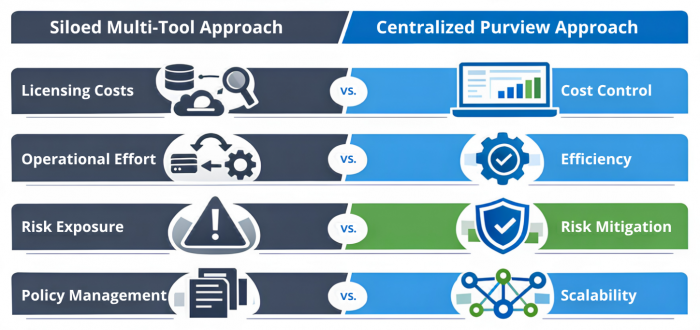
Organizations that choose not to centralize their metadata pay a steep premium in both licensing costs and administrative friction.
A siloed multi-tool approach often demands separate licensing, separate administration, duplicate discovery work, and inconsistent policy management across platforms. By contrast, a centralized Purview approach allows organizations to reuse one governance layer across multiple environments. This reduces redundant effort while improving visibility and consistency.
- Licensing costs: Maintaining separate governance, scanning, classification, and reporting tools for each platform can increase total cost of ownership. Centralized metadata management helps reduce duplication by allowing the organization to govern multiple environments through a more unified operating model.
- Operational effort: Siloed tools force IT, security, compliance, and data teams to learn and maintain several disconnected systems. A centralized catalog reduces manual reconciliation and gives teams a common place to search, compare, and prioritize findings across sources.
- Risk exposure: Reviewing each platform separately means sensitive data may be overlooked, inconsistently classified, or discovered too late. Centralized scanning and classification help the organization identify risk patterns across the full data estate.
- Policy management: Separate tools often produce inconsistent labeling, retention, access, and remediation practices. A centralized governance model supports more scalable and consistent policy design across Microsoft, cloud, SaaS, on-premises, and legacy environments.
How Collective Intelligence Can Help
Multi-cloud governance is rarely a software challenge alone. Rather, it is, at its core, an architectural and structural challenge. Most organizations struggle with the complexity of fragmented data sources and labor-intensive setup phases.
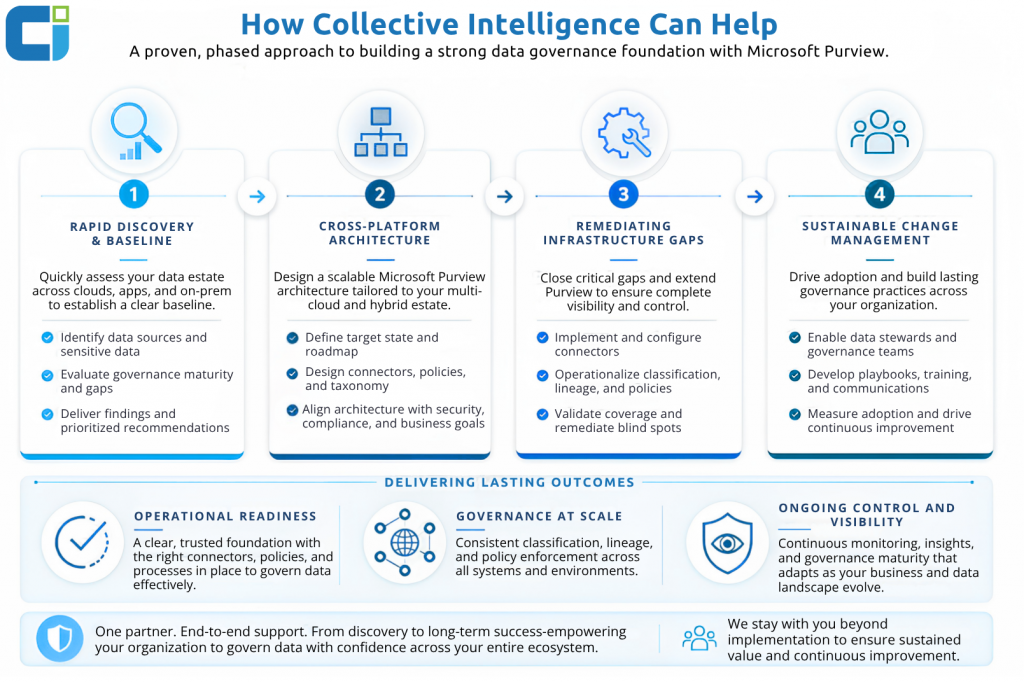
At Collective Intelligence, we take a proven, pragmatic approach to turning Purview into a fully operational engine for multi-cloud data security. Our established playbook breaks down infrastructure silos and maximizes your Purview investment:
- Rapid Discovery and Baseline Across Clouds: Our team activates Purview’s discovery stack to reveal where sensitive data lives and how it moves. This covers not just Microsoft environments, but your AWS, Google Cloud, and third-party environments, as well.
- Cross-Platform Architecture: We design sensitivity labels and DLP policies so that compliance enforcement stays consistent across M365, endpoints, browsers, and external cloud databases.
- Remediating Infrastructure Gaps: We fix the identity, access control, and network infrastructure gaps Purview alone cannot address. This ensures secure, cross-cloud communication.
- Sustainable Change Management: We deliver admin runbooks and responder playbooks so your IT Architects and Business Librarians can confidently manage cross-platform data alerts.
Universal Visibility is No Longer Optional
In a modern enterprise, data does not stop at the borders of the Microsoft ecosystem. Treating your data estate as a collection of isolated islands will inevitably produce compliance failures and operational friction. Purview, deployed as a multi-cloud single pane of glass, delivers complete visibility, robust cost control, and automated compliance. Therefore, it guarantees that your organization stays secured, structured, and fully prepared for the age of AI.
Take the Next Step: The CI Purview Discovery and Baseline Assessment
Are you ready to uncover what lives in your non-Microsoft data silos? Collective Intelligence specializes in helping organizations unlock the full power of Microsoft Purview across their entire hybrid estate.
Our Rapid Discovery and Baseline Assessment quickly maps your fragmented data sources, reveals your true risk posture, and delivers a clear, prioritized roadmap for universal data security.
Ready to understand where your sensitive data lives across your hybrid estate? Contact Collective Intelligence or schedule a brief virtual meeting to discuss a Multi-Cloud Purview Assessment.