


A CFO-Focused Look at the Financial and Legal Cost of Dark Data
Corporate executives often view data governance as a non-revenue-generating IT expense. But a closer look at the modern balance sheet reveals a different story: unmanaged information is a significant, hidden liability. Disorganized data estates silently drain financial resources. At the same time, they create unnecessary exposure to regulatory penalties.
The Cost of Storing What You Cannot See
Your organization pays considerable fees to store data that no one uses, no one can locate, and that could eventually haunt you in a court of law. Cybersecurity professionals call this unindexed, unmanaged information Dark Data.
In fact, a typical enterprise fills over half its storage with redundant, obsolete, or trivial records. For example, cloud environments routinely host seven-year-old email drafts, duplicate spreadsheets, and legacy server backups. More critically, these unmanaged silos frequently expose high-risk financial documents. Employee folders often scatter unencrypted spreadsheets containing legacy banking routing numbers, historical payroll data, or old tax identifiers. This digital clutter not only inflates storage costs but also slows employees down during their daily search for information. Most importantly, though, every unmanaged file expands the “surface area” that attackers can exploit during a network breach.
The Purview Solution: Data Lifecycle Management
Microsoft Purview Data Lifecycle Management can achieve substantial cost control. The platform directly delivers tool consolidation and reduced breach risks. Instead of letting data accumulate indefinitely, it establishes automated retention and deletion policies to govern information throughout its entire lifecycle.
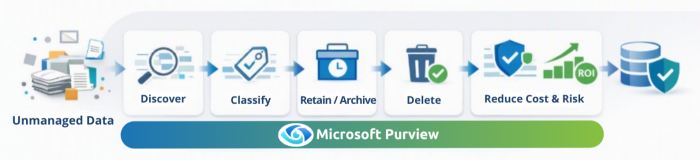
Two primary mechanisms drive these financial and operational benefits:
- Storage Cost Optimization: Purview uses automated classification workflows to identify obsolete files. Once flagged, these records can be safely archived or permanently deleted based on corporate policy. As a result, this shrinks premium cloud storage tiers and curbs unnecessary technology expenses.
- Reduction of the Breach Surface Area: The volume of compromised records largely determines the financial impact of a data breach. So, when you systematically purge old, unvetted documentation from your network, you leave fewer targets for external actors. Simply put, data that doesn’t exist on your servers can’t be stolen during a cyberattack.
The Operational ROI of Data Lifecycle Management
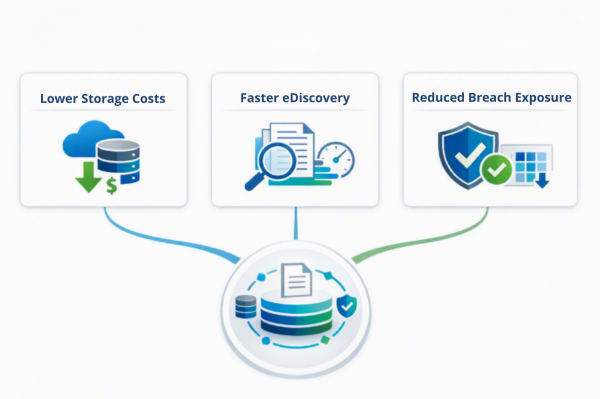
To help financial executives evaluate this shift, the table below contrasts the predictable savings of automated data management against the compounding liabilities of unmanaged growth:
| Operational Metric | The "Status Quo" (Unmanaged Expansion) | The "Purview Operationalized" Model |
|---|---|---|
| Premium Storage Costs | Compounding annually as redundant, obsolete, and trivial data expands unchecked. | Optimized: Automated deletion and archiving tiers actively shrink the digital footprint. |
| eDiscovery & Litigation Prep | Expensive legal teams spend days or weeks manually scanning unindexed server files. | Compressed: Indexed data and standardized review sets allow rapid, defensible extraction. |
| Breach Financial Exposure | Attackers can exfiltrate every historical file on the network during an attack. | Minimized: Purging expired records continually reduces the regulatory risk surface area. |
Decoding the Financial Value of the Compliance Score
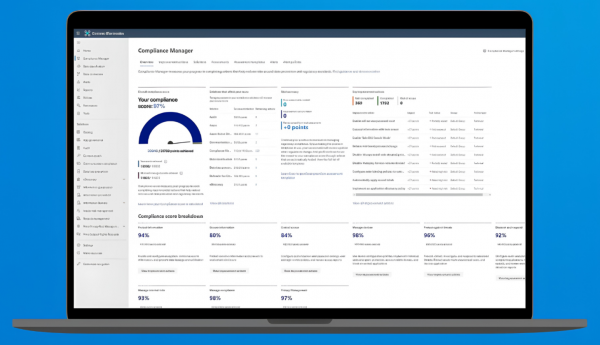
The Microsoft Purview Compliance Manager provides a tangible, numerical assessment of your data posture, tracking built-in regulatory controls and audit readiness. In turn, this metric directly quantifies operational velocity and risk reduction.
The Financial Correlation of a 10-Point Score Increase
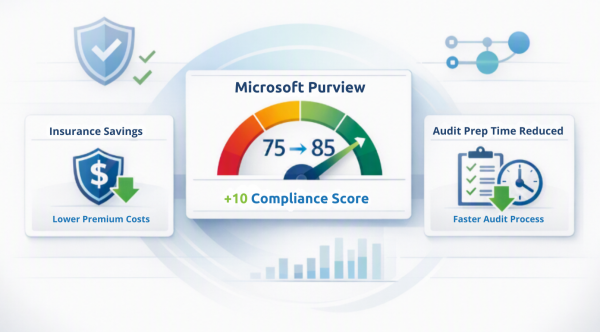
When your corporate Compliance Score climbs 10 points, you will see a direct correlation to financial savings in two critical areas:
- Reduction in Cyber Insurance Premiums: Underwriters increasingly price insurance policies based on demonstrable data hygiene. So, when you implement verified compliance controls via Purview, you present a lower risk profile to insurers, who in turn grant substantial premium discounts.
- Compression of Audit Preparation Time: Legal and compliance teams typically waste hundreds of hours on manual audit prep. However, once you codify repeatable, defensible processes in Purview, the time required to generate compliance reports drops drastically, freeing expensive human capital for strategic business initiatives.
The Path to Score Acceleration
Random configuration adjustments will not raise your corporate Compliance Score. Instead, a structured roadmap targets high-value, low-effort compliance gaps first.
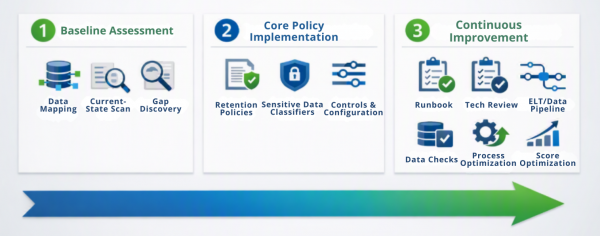
- Baseline Assessment: We conduct initial data mappings to establish your current performance baseline, revealing hidden vulnerabilities within your existing infrastructure.
- Core Policy Implementation: We deploy automated retention schedules and universal sensitive data classifiers across the entire environment, instantly elevating the foundational layer of the Compliance Score.
- Continuous Improvement: We use ongoing technical reviews, operational runbooks, and periodic assessments of ELT and other data-gathering processes to maintain and continuously optimize the score as your corporate data scales.
How Collective Intelligence Can Help
Activating Purview is often complex, thanks to fragmented data sources and labor-intensive setup phases. That is why Collective Intelligence (CI) uses a proven, pragmatic approach to align your governance model with real business domains.
Our playbook transforms data compliance into an automated, value-creating engine:
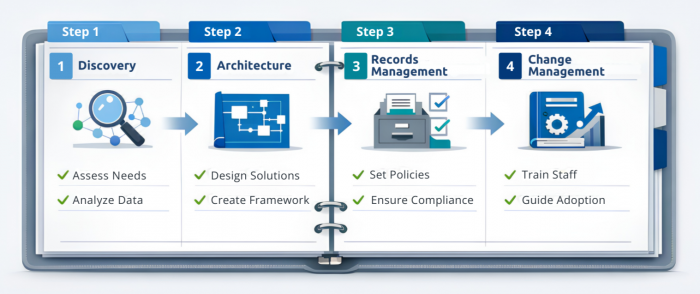
- Rapid Discovery and Baseline: Our team builds your prioritized roadmap for Data Loss Prevention (DLP) and security by activating Purview classifiers and Content Explorer.
- Business-Aligned Architecture: CI designs sensitivity labels and retention policies to mirror your actual operations across HR, Finance, and Legal departments.
- Operationalized Records Management: We codify holds, retention schedules, and review sets, giving your compliance officers repeatable, legally defensible workflows.
- Change Management and Training: We reduce operational friction by delivering runbooks, user prompts, and playbooks that ensure long-term adoption.
Turning Clean Data into a Strategic Asset
Do not regard clean data merely as a regulatory requirement. Instead, understand it as a fundamental pillar of corporate financial efficiency. When you use Purview as a single platform for visibility, security, and compliance, it automates operational workflows and eliminates waste. In turn, you gain total control over your corporate information, rendering your organization highly efficient, fully protected, and entirely ready for the age of AI.
Take the Next Step: The CI Purview Assessment
Are you ready to quantify and eliminate your hidden data liabilities? With the assistance of Collective Intelligence, you can unlock the full power of Microsoft Purview.
Our Rapid Discovery and Baseline Assessment maps your data estate, isolates storage waste, and provides a clear, prioritized roadmap for ROI-driven data governance. Then, our consultants directly apply the operational frameworks outlined in our CI Microsoft Purview Sheet to turn your corporate data into a secure, cost-effective asset.
Contact Collective Intelligence to learn more or schedule a brief virtual meeting to discuss your Purview ROI Assessment.